

The Upside of Stress: Why Pressure Signals Growth
Stressed? Good.
The email is late.
The next appointment is in ten minutes.
Prospects are asking detailed questions.
The VA needs direction.
The CPA needs documents.
The community expects leadership.
The board wants clarity.
The list keeps growing.
For many people, this feels like overload. For high performers, it is something else entirely. It is a signal.
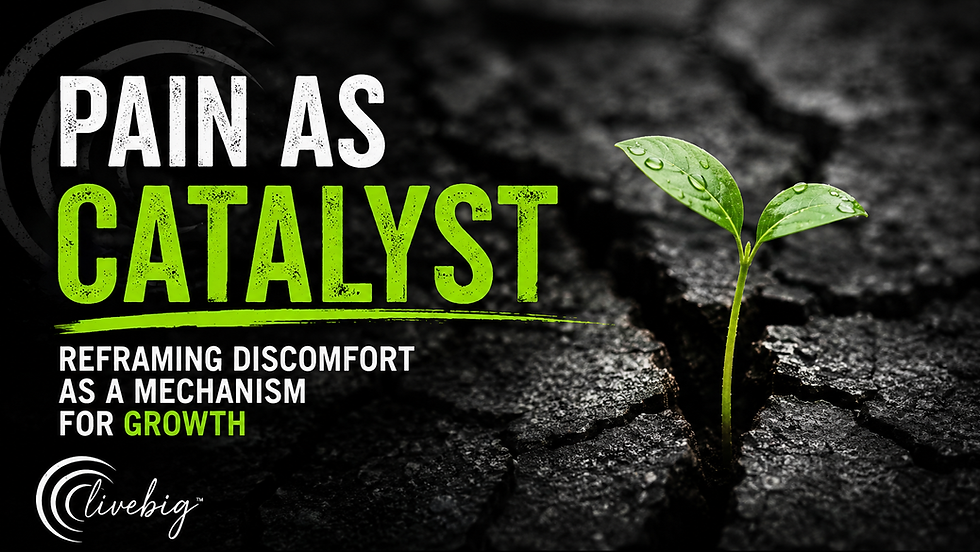
Stress is not the enemy. It is often the sensation of expansion.
Stress Is Friction — And Friction Builds Strength
In physics, friction creates resistance. In the gym, resistance builds muscle. In business and life, pressure builds capacity.
The feeling commonly labeled as “stress” is often the psychological friction that occurs when growth is happening faster than comfort. It is the nervous system adjusting to new levels of responsibility, visibility, and expectation.
Without friction, there is no adaptation.
Avoiding stress entirely leads to stagnation. Muscles atrophy without resistance. Skills decay without challenge. Confidence erodes without proof of capability.
The easy road rarely produces meaningful results. It produces comfort. And comfort, when overextended, produces weakness.
The Science of Positive Stress
Not all stress is the same.
Psychologists distinguish between:
Distress – the negative, overwhelming kind of stress that leads to anxiety, paralysis, or burnout.
Eustress – positive stress that fuels motivation, focus, and growth.
The concept of eustress was popularized by endocrinologist Hans Selye, who discovered that stress responses are not inherently harmful. In fact, moderate, meaningful stress improves performance.
Athletes rely on it.
Entrepreneurs depend on it.
Leaders sharpen themselves through it.
When a deal feels intimidating, when the calendar fills up, when expectations rise — that pressure often indicates forward motion.
If a $40,000 contract feels overwhelming, it may simply mean the operating system is upgrading.
The Real Difference: Interpretation
Stressors are neutral events. The meaning assigned to them determines whether they empower or diminish.
Two people can face the same scenario:
A full inbox.
A demanding client.
A high-stakes presentation.
One interprets it as threat.
The other interprets it as opportunity.
Research from Stanford psychologist Kelly McGonigal shows that individuals who view stress as enhancing rather than debilitating perform better under pressure and experience improved long-term health outcomes.
The stress itself is not the deciding factor.
The interpretation is.
The Average Reaction vs. The Leadership Reaction
The average response to stress focuses on obstacles:
“My boss is the problem.”
“The economy is the problem.”
“Debt is the problem.”
“The market is saturated.”
This orientation externalizes responsibility.
Leaders do something different.
They lean into the wind.
They assume responsibility.
They accept the pressure.
They decide that friction equals forward motion.
When stress is reframed as proof of expansion, the narrative changes from “Why is this happening to me?” to “What capacity is being built here?”
Overwhelm as a Sign of Abundance
Overwhelm is often mislabeled scarcity.
A calendar packed with meetings may signal growth.
Prospects asking detailed questions may signal serious buying intent.
A team seeking direction may signal influence expanding.
Being overwhelmed by opportunity is a luxury many people claim they want — until they experience it.
If the inbox is full because the market is paying attention, congratulations are in order.
The solution is not to retreat.
The solution is to rise.
The Danger of Avoiding Stress
Avoiding stress may feel like safety, but it often creates long-term fragility.
When individuals consistently choose comfort over challenge, several consequences emerge:
Skills plateau.
Confidence shrinks.
Opportunities pass by.
Fear grows larger than reality.
The irony is clear: avoiding manageable stress now creates unmanageable stress later.
Choosing short-term ease frequently produces long-term anxiety.
Choosing short-term discomfort often produces long-term freedom.
Elite Performers Train Under Pressure
High-level performers deliberately expose themselves to stress.
Athletes train beyond game conditions.
Executives rehearse worst-case scenarios.
Entrepreneurs pitch investors who might say no.
They understand something crucial: capacity expands only under load.
No one closes meaningful deals without feeling something.
No one builds influence without facing scrutiny.
No one scales a company without experiencing operational tension.
Pressure is not proof of inadequacy. It is proof of expansion.
Turning Stress Into Strategic Fuel
Stress becomes powerful when it is directed rather than suppressed.
Here are five practical ways to harness it:
1. Separate Signal From Story
The physical sensation — elevated heart rate, heightened alertness — is neutral.
The story attached to it determines the outcome.
Replace “I’m overwhelmed” with “I’m leveling up.”
2. Break the Load Into Action
Overwhelm dissolves when translated into next steps.
Instead of staring at the $40k deal, identify the next call, the next email, the next proposal revision.
Progress reduces anxiety.
3. Delegate Intelligently
Leadership stress often stems from growth outpacing systems.
Use VAs, CPAs, and team members as force multipliers rather than last-minute backups.
Structure reduces chaos.
4. Recover Deliberately
Positive stress requires recovery cycles.
Sleep, exercise, and mental reset are not indulgences; they are performance requirements.
Stress without recovery becomes distress.
5. Anchor to Purpose
Pressure without meaning feels suffocating.
Pressure aligned with purpose feels powerful.
When stress connects to a mission larger than ego, it transforms into fuel.
The Threshold Moment
Every meaningful breakthrough carries a moment of intimidation.
The first large contract.The first keynote.The first hire.The first expansion.
That internal voice may whisper, “This is too much.”
That whisper is not a warning to retreat. It is often a threshold.
Crossing it requires courage, not comfort.
Leadership Lives on the Edge
When individuals lean into stress rather than shrink from it, something shifts.
They move from reacting to leading.
From coping to commanding.
From surviving to building.
Leadership is rarely relaxed at the beginning. It becomes relaxed through repetition and competence.
The edge eventually becomes familiar territory.
What once felt overwhelming becomes routine.
What once felt impossible becomes baseline.
Stress as a Privilege
Consider the alternative to stress.
No prospects.
No deadlines.
No responsibilities.
No expectations.
That absence may feel peaceful at first. Over time, it becomes stagnation.
Being trusted with responsibility is a privilege.
Being challenged by growth is a privilege.
Being overwhelmed by opportunity is a privilege.
Stress often indicates that the world is asking for more capacity.
The Upgrade Mindset
When the deal feels big, when the expectations feel heavy, when the workload stretches beyond comfort — it may not be a warning.
It may be an upgrade notification.
Operating systems expand through pressure.
Identity expands through responsibility.
Capacity expands through repetition.
The sensation of “This is a lot” frequently precedes “This is normal.”
Welcome to the Club
Feeling intimidated by a larger stage?
Perfect.
Feeling stretched by a bigger number?
Excellent.
Feeling pressure because expectations have increased?
Welcome.
This is the territory of builders, creators, and leaders.
The club is not exclusive because it is glamorous. It is exclusive because many people step back when pressure rises.
Those who step forward discover something powerful:
Stress, when harnessed, becomes strength.
The next time the inbox fills up, the calendar tightens, and the deal feels bigger than comfort allows, pause.
Interpret the friction correctly.
This is growth.
Now execute.
LIVEBIG 🌎


Comments