

Turn Pain into Purpose: Transforming Hardship into Global Impact
Throughout history and in our current world, hardship has been a common thread in the stories of individuals who have changed the world. While pain and struggle are often viewed as setbacks or sources of suffering, they also carry immense power. Pain is not designed merely to wound us—it is here to guide, instruct, and ultimately elevate us. If you aren’t using your hardships to create value for others or spark positive impact, you're not just delaying growth—you’re neglecting your full potential.
The Guiding Force of Pain
Pain has always been one of humanity’s most profound teachers. From ancient civilizations to modern social movements, struggle has ignited clarity, courage, and creativity. It’s not just a private burden; it can become a public gift when we choose to use it.
Example from History: Nelson Mandela
Nelson Mandela is perhaps one of the most powerful examples of someone who turned personal pain into global purpose. Arrested and imprisoned for 27 years for opposing South Africa’s apartheid regime, Mandela could have emerged from prison bitter and broken. Instead, he transformed his suffering into a platform for peace, reconciliation, and justice. Upon his release, he led negotiations that ended apartheid and became South Africa’s first Black president. Mandela’s personal sacrifice laid the groundwork for a democratic nation, teaching the world that forgiveness and wisdom can be born from deep pain.
Turning Pain into a Catalyst for Change
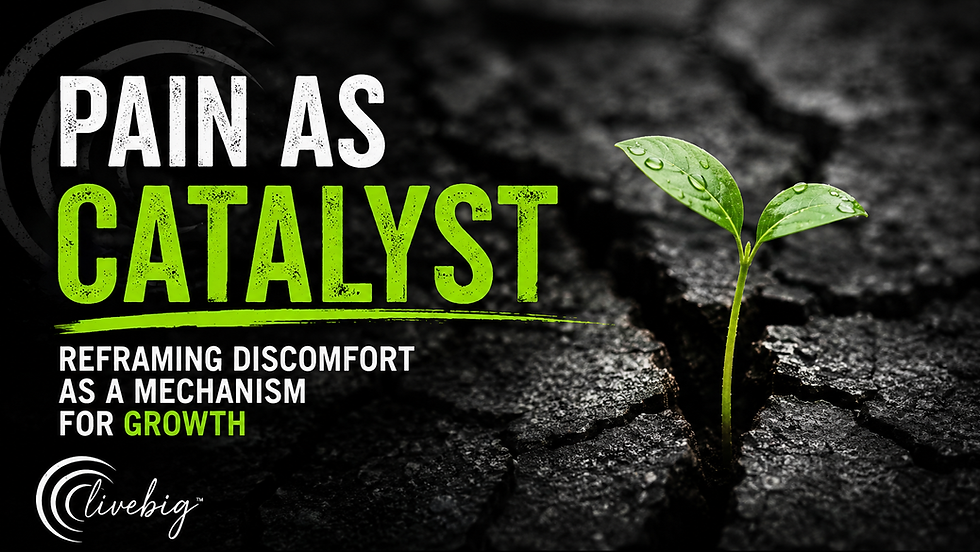
Pain itself doesn't guarantee growth. The power lies in how we respond to it. When pain is ignored, repressed, or denied, it often becomes destructive. But when it’s examined and channeled, pain becomes a catalyst.
Modern Example: Malala Yousafzai
Malala Yousafzai was just 15 years old when she was shot in the head by the Taliban for advocating for girls’ education in Pakistan. Many would have understandably retreated into silence. But Malala chose to speak louder. Her injury became her message. She co-authored I Am Malala, addressed the United Nations, and became the youngest-ever Nobel Peace Prize laureate. Today, the Malala Fund supports girls’ education in multiple countries. Her pain sparked a movement that now changes thousands of lives.
Challenges as Learning Experiences
Rather than viewing difficulties as punishments or failures, we can view them as preparation. Pain refines character, teaches resilience, and builds depth.
Historical Insight: The Great Depression and Innovation
During the Great Depression of the 1930s, tens of millions of people around the world faced economic devastation. Yet this period of hardship also sparked innovation and social transformation. In the United States, President Franklin D. Roosevelt implemented the New Deal—a sweeping series of programs that expanded infrastructure, supported labor rights, and redefined the role of government in people’s lives. Many foundational aspects of today’s welfare and labor systems were born out of that era’s pain. What was once economic despair became a blueprint for social advancement.
Contemporary Example: COVID-19 Pandemic
The COVID-19 pandemic is another profound global example. While it brought loss, uncertainty, and isolation, it also accelerated global innovation. The pandemic led to the rapid development of mRNA vaccine technology, revolutionized how we think about remote work, and reignited conversations about public health, supply chains, and community support. In countless homes and neighborhoods, ordinary people stepped up to help each other. Pain revealed both our vulnerabilities and our collective strength.
Be the Change You’re Hungry For
Transformation starts with personal decision. It’s tempting to wait for others to fix problems, to seek comfort instead of purpose. But history honors those who turned inner hunger into outer impact.
Example: Viktor Frankl and Meaning
A Holocaust survivor and psychiatrist, Viktor Frankl endured years in Nazi concentration camps. He lost his parents, wife, and brother. Amid unthinkable suffering, he developed a revolutionary psychological theory called logotherapy, based on the idea that finding meaning is the primary human drive. In his book Man’s Search for Meaning, Frankl wrote, “When we are no longer able to change a situation, we are challenged to change ourselves.” His suffering became the foundation for one of the most influential frameworks in modern psychology, helping millions find purpose in their own lives.
Everyday Example: Marcus Bullock and Flikshop
After serving eight years in prison for a carjacking he committed at age 15, Marcus Bullock emerged with a mission. He built Flikshop, a tech company that allows families to send photos and messages to incarcerated loved ones. His pain from incarceration gave rise to a tool that now connects thousands of families and promotes rehabilitation, proving that even personal tragedy can be turned into societal benefit.
Conclusion: Your Hardship Has Value
Every person will face struggle. But the way we choose to respond—whether we use that experience to rise, grow, and give—determines whether our pain becomes wasted or redeemed.
You don't need to be famous or have a platform to turn pain into purpose. The smallest action—mentoring someone, sharing your story, solving a problem in your community—can be a seed of world change. Your challenges hold hidden value, not just for you, but for everyone who could benefit from your growth.
The world doesn’t need more perfection—it needs more people who are real, resilient, and ready to turn their pain into purpose.
Let's make it happen. #LIVEBIG


Comments